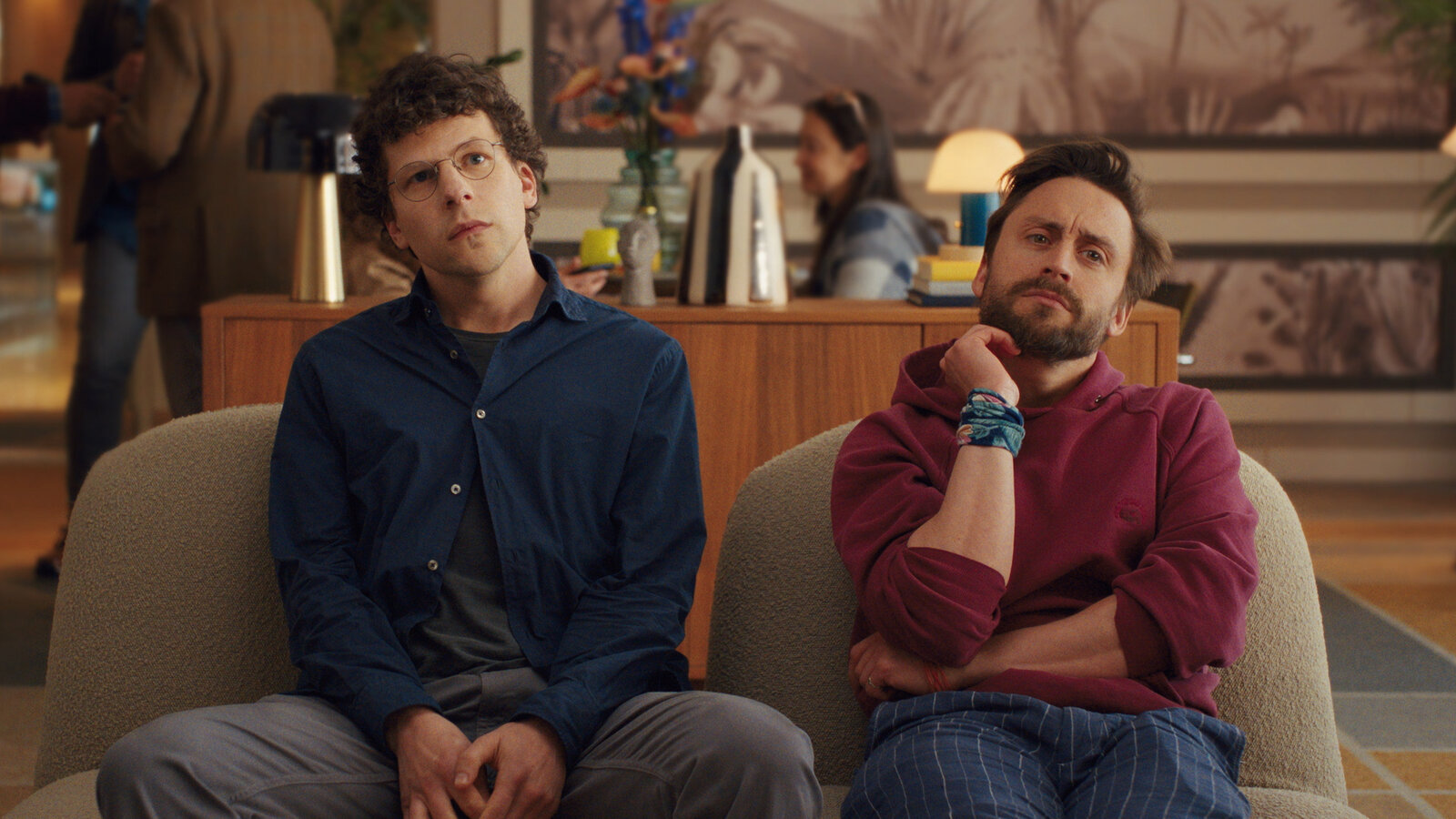
In the simplest of definitions, Jesse Eisenberg’s A Real Pain is a small movie with a lot of big ideas. It touches on family, loss, the weight of our past, and how we choose to deal with suffering, among other things. But, it remains grounded due in small part to its fairly simplistic, if circuitous, plot—and in large part to the incredibly human connection shared by its two main characters.
The film follows cousins David Kaplan (Eisenberg) and Benji Kaplan (Kieran Culkin) as they travel from New York to Poland on a Jewish-heritage tour to honor their recently deceased grandmother who was a Holocaust survivor. We quickly learn that these cousins, who are only three weeks apart in age, were close enough to be considered brothers when they were younger, but have since drifted apart. Now, as 40ish year-olds, David is happily married with a young child and a steady career. Contrarily, Benji is an aimless and youthful slacker who lives with his mother and smokes a lot of weed. David is overly-cautious, anxious, and aggressively organized. Benji, while clearly being highly intelligent, is unpredictable, uninhibited, and unafraid to vocalize any and every thought that pops into his head.
A Real Pain feels most alive in the moments when David and Benji’s specific yet universal relationship dynamic is at the center of the frame. The movie succeeds due to its willingness to examine the burden that comes with loving the flawed and calamitous people in our lives, as well as how our individual pasts, and the passage of time, impacts our ability to do so.
On their tour, David and Benji are joined by four other tourists. There’s Marcia (Jennifer Gray), the middled-aged divorcée seeking meaning in her recently unfulfilling life; Mark (Daniel Oreskes) and Diane (Liza Sadovy), a retired couple from Ohio traveling to learn more about the life of Mark’s father; and Eloge (Kurt Egyiawan), a Rwandan man who survived the genocide in his home nation before moving to Winnipeg and converting to Judaism. These characters, along with James (Will Sharpe), the friendly and well-educated British tour guide leading this group, mainly function as a way to further draw out the complicated, combative, and sincere dynamic that exists between David and Benji.
We are introduced to David’s timidity and Benji’s undeniable charisma when the group stops at a World War II memorial which features 15+ foot tall statues of the Polish soldiers who fought against the nazis. Benji quickly mobilizes the group to pose alongside the statues as if they themselves are on the battlefield. David declines the invitation and, instead of participating, is handed four cell phones to take individual pictures for everyone. Several other times in the film, we see David feeling the need to apologize to the group after Benji has an emotional outburst which often reaches the point of being confrontational. These outbursts are not a rare occurrence. In these moments, the inner workings of David and Benji’s relationship become clear. If you’ve ever had someone in your life that you love while also hate, envy while also pity, are afraid to lose while also can’t bear to be around—or if you’ve ever known someone who can easily light up any room they walk into but can also just as easily say something in that room that you will feel obligated to apologize for on their behalf—then this film’s central connection will resonate with you deeply.
At one point or another most of us have found ourselves in awe as we watch someone we know possess the precise amount of nonchalant confidence needed to not only bond with, but charm, a seemingly uninterested stranger. In A Real Pain, this plays out early in the film as David, after quickly moving through the security line, witnesses Benji’s ability to have a meaningful and personal conversation with a TSA agent. This brief moment serves as a template for how Eisenberg and Culkin’s characters choose to move through the world. Benji takes the time to observe, interact with, and truly feel the world he inhabits, while David finds it most beneficial and efficient to politely push through the formalities of life without burdening those around him.
Throughout the heavily emotional “Holocaust Tour” the two are on, we see that these approaches also mirror how our two main characters choose to deal with pain. David sees it fit to just get on with life. He feels that since we are all struggling, his pain is far too ordinary of a thing to bother everyone else with. He would rather focus on the good things in life, like his family, and push down the pain to a place where it doesn’t have to be acknowledged. On the other hand, Benji is a deep feeler. He experiences both the highs and lows of life on an intense level, and sees nothing wrong with sharing those emotions. In fact, he is incensed with those who he thinks are not feeling, or interacting with the world, enough. It is a much more youthful, almost childlike, approach—but that doesn’t mean he is wrong. He can be jaded, pseudo-nihilistic, and bluntly honest just up to the point of being rude at times, but is never cynical enough to simply ignore the cruel realities of the world. He is certainly troubled, but has not reached the point of being numb to it all.
In an emotional monologue delivered beautifully by Eisenberg, David discusses Benji with the rest of the tour group and says “I love him, I hate him, I want to kill him, and I want to be him.” This is the sentiment at the core of their relationship. David wants to protect Benji while also wanting to strangle him—at the same time he is embarrassed and frustrated by him, he knows he’d be better off if he was a little bit more like him.
Obviously, the title of this film is a pun. To David, dealing with Benji if oftentimes “a real pain.” But through Benji, the film focuses on how people experience real pain, and how that pain reverberates itself throughout history. In the closing moments of the film, we are shown a closeup of Culkin’s face as he sits alone. In a single expression, we see the uncertainty that his character feels. We want to imagine a hopeful future for Benji but recognize that he is, at the very least, unsure if that future will ever actually come. For most of the story, we understand David’s pain when it comes to his complicated feelings towards Benji, but in that final moment, we more clearly understand Benji’s pain that comes with being the “him” referenced in David’s earlier monologue to the group.
Rating: 4.0 out of 5


One thought on “‘A Real Pain’: A Touching Examination of the Complexities of Human Connection”